
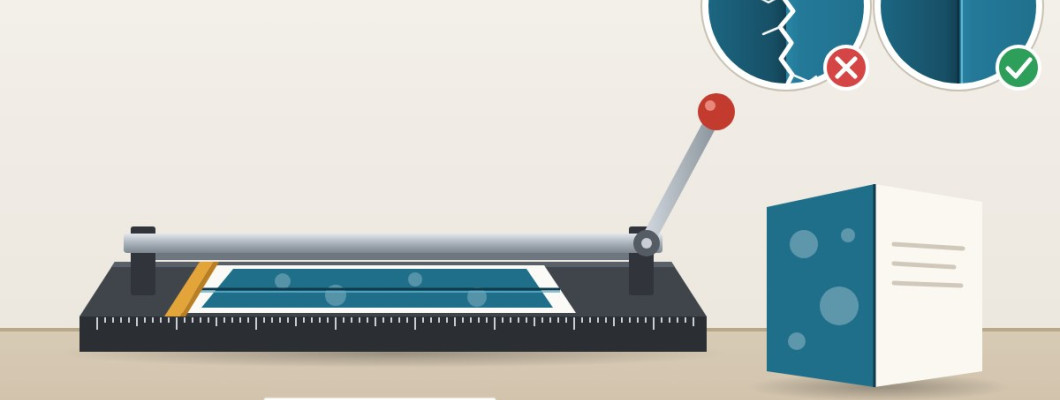
Anyone who folds invitations, greeting cards, menus or flyers from heavy paper knows the problem: the paper cracks at the fold, the print splits and the edge looks untidy. The answer is not expensive special paper, but a crease before folding. In this guide we explain what creasing is, when you need it and what to look for in a creasing machine.
What is creasing?
Creasing presses a line into the paper without cutting it. The fibres are compressed at that point and form a kind of hinge. When you then fold the paper along the crease, it bends cleanly at exactly that point instead of cracking on the surface.
Three terms are often confused:
- Creasing (scoring): a line is pressed in, the paper stays whole. This prepares a clean fold.
- Folding: the paper is bent along a line.
- Perforating: the paper is pierced along a line with small cuts so that it can be torn off, for example on tickets or vouchers.
When do you need to crease paper?
Thin copy paper can be folded without preparation. The thicker and stiffer the paper, the more likely it is to crack when folded. Creasing is especially worthwhile:
- on card and heavy paper, for example for cards, folders and envelopes
- on digital prints, because the toner sits on the paper and splits easily at the fold
- on fully printed or laminated sheets, where a crack is immediately visible
- when the fold runs across the grain of the paper
TIP: Paper has a grain direction in which the fibres lie. It folds more easily parallel to the grain. If you have to fold across it, creasing is especially important.
What a creasing machine is used for
- Invitations, wedding cards and greeting cards
- Restaurant menus
- Flyers and folded leaflets
- Photo books and photo albums
- Folders, envelopes and small packaging
Manual or electric creasing machine?
A manual creasing machine is operated with a lever. It needs no power, is quiet and compact, and suits copy shops, print shops, agencies and creative workshops with small and medium runs. Each sheet is placed and creased individually.
An electric or automatic creasing machine feeds the sheets by itself and creases them in series. It pays off if you regularly process very large quantities. It is, however, much more expensive and takes up more space.
For most small businesses and for occasional use, a manual machine is enough.
What to look for when buying
- Working width: it determines how long the crease can be. For A3 sheets you need at least about 42 cm.
- Paper weight: check up to which weight the machine creases. For cards and board it should be well above 300 g/m².
- Guides and scale: with side guides and a millimetre scale the crease sits in the same place on every sheet. That matters when you make many identical cards.
- Laminated sheets: if you laminate your prints first, the machine should also be able to crease laminated material.
- Stability: a heavy metal frame does not slip while you work and lasts longer.
Our manual A3 creasing machine has a working width of 48 cm, creases paper and card from 80 to 450 g/m², including laminated material, and has two side guides with a millimetre scale.
How to crease paper correctly
- Set the position: mark on a test sheet where the fold should be and set the guide using the scale.
- Place the sheet: lay the sheet straight against both guides.
- Crease: press the lever down evenly all the way.
- Check: fold the first sheet and check that the edge is clean and the print does not crack.
- Fold: fold so that the pressed-in groove is on the inside and the raised bead on the outside. This way the surface cracks least.
TIP: With new paper always make two or three test sheets first. Every paper behaves a little differently.
Creasing, perforating and cutting: the right equipment
If you finish cards, flyers and tickets yourself, you usually need three steps: cutting, creasing and sometimes perforating.
- For cutting whole stacks: our A3 paper cutter
- For tear-off lines on tickets, coupons and forms: our perforating machine for paper and card up to 350 g/m²
- For clean folds: the A3 creasing machine
You will find all finishing equipment in our paper cutter category.
Frequently asked questions
Is a creaser the same as a scoring machine?
Yes. Both terms describe the same machine, which presses a line into paper or card so that it can be folded cleanly.
From what paper weight should you crease?
There is no fixed limit, because paper type, grain direction and print also play a role. On card and heavy paper for cards, creasing almost always makes sense. If the paper cracks or the print splits on a test fold, you should crease.
Can laminated sheets be creased?
Yes, if the machine is suitable. Our manual A3 creasing machine also creases laminated material.
Leave a Comment