
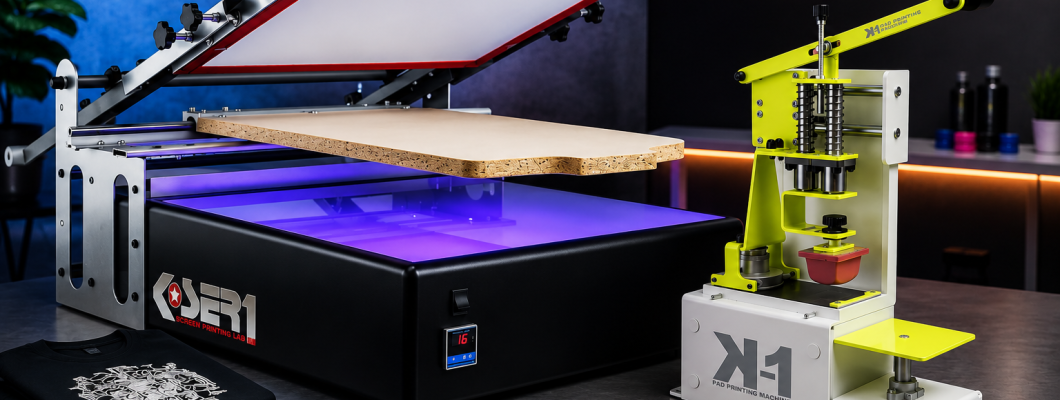
Anyone new to product printing runs into the same question sooner or later: screen printing or pad printing? These two techniques are often mentioned together, sometimes as if they were interchangeable, but in reality they answer very different needs. Understanding how each works, where it excels and where it struggles is the first step to avoid investing in the wrong equipment for your project.
There's no technique that's "better" in an absolute sense. There's a technique that's more suited to a particular object, surface, quantity and budget. This guide compares the two technologies in a practical way, without unnecessary jargon, to help you work out which of the two — or whether you need both — makes sense for what you want to produce.
How Screen Printing Works
Screen printing is a direct printing technique. A frame, tensioned with mesh (usually polyester), is coated with a light-sensitive emulsion that, once exposed, forms a stencil: the design areas remain open, the rest of the mesh is blocked. Ink is then pushed through the mesh with a squeegee, directly onto the surface being printed.
The result is a relatively thick ink deposit, with good coverage even on dark fabrics or surfaces that aren't perfectly smooth. Each colour requires a separate frame, so preparation time increases with the number of colours in the design.
Screen printing works well on flat or slightly curved surfaces: t-shirts, hoodies, posters, cardboard, panels, textiles in general. It's less suited to complex three-dimensional objects, spherical items or tight angles, where the mesh can't make even contact.
How Pad Printing Works
Pad printing is an indirect printing technique. The design is engraved onto a plate, called a cliché, made of metal or photopolymer. The plate is inked, then a silicone pad — soft and deformable — picks up the image from the cliché and transfers it onto the object, conforming to its shape during contact.
This is pad printing's strength: the pad deforms to follow curved, concave, cylindrical or irregular surfaces, something screen printing simply can't do. The ink layer deposited is thinner than with screen printing, which allows very fine details, small logos and tiny text to be reproduced with good sharpness.
Pad printing is the typical choice for pens, lighters, promotional items, electronic components, caps, or small plastic or metal objects. It's less suited to very large surfaces, where the pad would need difficult-to-handle dimensions, and cost per piece on large formats generally climbs quickly.
Screen Printing vs Pad Printing: Direct Comparison
| Aspect | Screen Printing | Pad Printing |
|---|---|---|
| Printing type | Direct (through a mesh) | Indirect (via a pad) |
| Ideal surfaces | Flat or slightly curved | Curved, concave, cylindrical, irregular |
| Ink thickness | Greater, excellent coverage | Thin, excellent for fine detail |
| Print area size | Large (posters, garments, panels) | Small/medium (max a few cm) |
| Typical materials | Fabric, paper, cardboard, wood | Plastic, metal, glass, ceramic |
| Preparation time | One frame per colour | One cliché per colour, faster to prepare |
| Value on large volumes | High, especially on a single colour | Good for small objects, less so for large surfaces |
TIP: If your project involves both fabric items and small rigid gadgets, the most practical solution is often not to pick one technique, but to cover both needs with different equipment for each type of product.
When to Choose Screen Printing
Screen printing is the right choice when the object to be printed has a flat or nearly flat surface and is medium to large in size. It's the go-to technique for:
- T-shirts, hoodies and clothing in general
- Posters, banners and prints on paper or cardboard
- Tote bags and textile promotional products
- Runs with medium to large quantities of the same design
- Designs that need strong coverage, including on dark fabrics
When to Choose Pad Printing
Pad printing becomes the sensible choice when the object is small, three-dimensional, or has an irregular surface. It's suited to:
- Pens, lighters and small promotional items
- Electronic components and keypads
- Balls, spherical or cylindrical objects
- Very small logos and text requiring high sharpness
- Concave surfaces or tight angles, where screen printing can't make contact
Costs: What to Expect
Entry costs vary a lot depending on the level of automation and equipment quality, for both techniques. Generally, a basic screen printing setup (frame, squeegee, emulsion, inks) requires a relatively contained initial investment, while automation (multi-colour presses, dryers) raises the budget considerably. For pad printing, a manual single-colour machine represents the cheapest way in, while automatic multi-colour systems for high-volume production require a significantly higher investment.
Beyond the machine itself, you also need to factor in consumables: mesh, emulsions and inks for screen printing; clichés, pads and specific inks for pad printing. Both techniques also require exposure equipment (an exposure unit), essential for creating the stencil or the cliché.
TIP: Before investing, calculate the cost per piece based on the actual quantity you plan to produce — not just the machine price. On small runs, the difference between the two techniques often shows up more in preparation time than in material costs.
Common Mistakes When Choosing Between Screen Printing and Pad Printing
The first mistake, common among beginners, is choosing based on what "seems simpler" rather than the shape of the object. A pad printing machine won't help if the goal is printing t-shirts, just as a screen printing frame won't solve the problem of printing on a spherical surface.
The second mistake is underestimating preparation time per colour. With multi-colour designs, in both screen printing and pad printing, each additional colour means an extra frame or cliché, and therefore more time and higher setup costs — a factor that's often more decisive than the machine's price itself.
Finally, many people underestimate the learning curve. Both techniques require practice to get consistent results: alignment, pressure, ink amount and drying times are all variables you learn to control through experience, not just with the right equipment.
Conclusion
Screen printing and pad printing aren't in competition with each other: they cover different needs and, in many workshops, coexist side by side precisely because they respond to different types of products. The question to ask isn't which technique is objectively better, but which one fits the objects you want to customise, the quantities you plan to produce, and the level of detail your designs require.
If your project revolves around garments, posters or products with flat, large surfaces, screen printing remains the most efficient tool. If instead you're working with gadgets, small objects or curved surfaces, pad printing will give you results that screen printing simply can't replicate. Knowing this difference before you invest helps you pick the right equipment the first time, instead of finding out after the purchase.
Leave a Comment