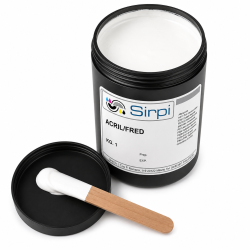
Pad printing ink is a specially formulated ink designed for use in the pad (tampo) printing process. It is engineered to transfer efficiently from an etched printing plate to a silicone pad and then onto a wide range of surfaces, including curved, textured, and irregular objects.
Pad printing ink plays a critical role in achieving sharp details, strong adhesion, and long-lasting prints. It is widely used in industrial marking, product branding, and promotional printing where precision and durability are required.
Key properties of pad printing ink
Pad printing ink is formulated to behave differently from standard printing inks in order to support indirect ink transfer.
Key properties include:
-
Controlled viscosity for clean ink pickup and release
-
Fast evaporation to support sharp image transfer
-
Strong adhesion to various substrates
-
High color opacity and detail resolution
-
Compatibility with silicone printing pads
These properties ensure reliable performance during the pad printing process.
How pad printing ink works in the printing process
Pad printing ink works by transferring in stages rather than directly onto the substrate.
The process typically includes:
-
Filling the etched image area of the printing plate with ink
-
Allowing solvents in the ink to partially evaporate
-
Picking up the ink from the plate using a silicone pad
-
Transferring the ink from the pad onto the product surface
-
Drying or curing the ink to achieve durability
Proper ink formulation is essential for clean release from both the plate and the pad.
Types of pad printing inks
Different applications and materials require different types of pad printing ink.
The most common types include:
-
Solvent-based pad printing inks for plastics and metals
-
One-component inks that air-dry or heat-cure
-
Two-component inks mixed with hardeners for extra durability
-
UV-curable pad printing inks for fast production
-
Specialty inks such as metallic, fluorescent, or textured inks
Choosing the correct ink type depends on the substrate and performance requirements.
Materials compatible with pad printing ink
Pad printing ink is designed to adhere to a wide range of materials.
Common compatible materials include:
-
Plastics such as ABS, PVC, and polypropylene
-
Metal and coated metal surfaces
-
Glass and ceramics
-
Rubber and silicone parts
-
Painted and lacquered surfaces
Surface treatment may be required for certain low-energy plastics.
Where pad printing ink is commonly used
Pad printing ink is used in industries that require precise and durable markings on small or complex objects.
Typical applications include:
-
Promotional products and branded merchandise
-
Electronics and control panel markings
-
Medical devices and laboratory equipment
-
Automotive components and parts
-
Consumer goods and product housings
Its versatility makes it suitable for both decorative and functional printing.
Advantages of using pad printing ink
Pad printing ink offers several advantages compared to general-purpose inks.
Main advantages include:
-
Excellent detail reproduction on small graphics
-
Strong adhesion on difficult surfaces
-
Compatibility with complex shapes and contours
-
Durable and wear-resistant finishes
-
Wide range of colors and specialty effects
Pad printing ink is a specialized ink formulated for indirect transfer using a silicone pad. Its unique properties allow for accurate, durable, and high-quality printing on curved and irregular surfaces across a wide range of industrial and commercial applications.