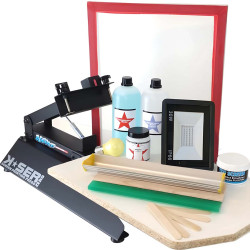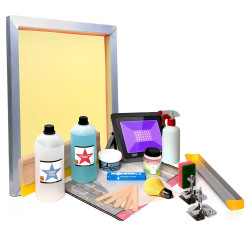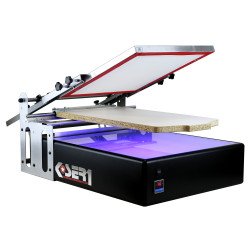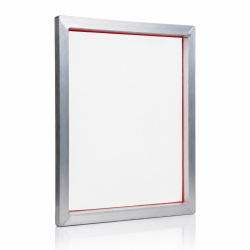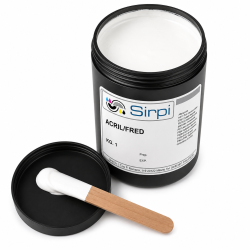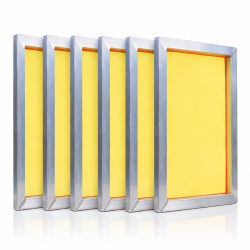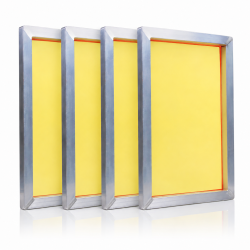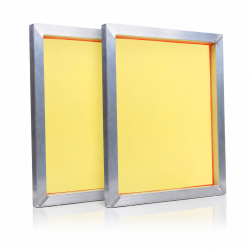
Mesh in screen printing refers to the woven fabric stretched tightly over a screen printing frame that allows ink to pass through and form an image on the substrate. The mesh acts as the foundation of the screen, controlling how much ink is deposited and how much detail can be reproduced in a print.
Modern screen printing mesh is typically made from polyester due to its strength, consistency, and resistance to chemicals. Mesh is one of the most important variables in screen printing, as it directly affects print quality, ink flow, and overall results.
The role of mesh in screen printing
Mesh plays a critical role in transferring ink accurately from the screen to the printed surface.
Its main functions include:
Supporting the emulsion stencil during printing
Allowing ink to pass through open areas of the design
Controlling ink volume and deposit thickness
Maintaining detail, sharp edges, and consistency
Without the correct mesh, even high-quality inks and emulsions cannot produce clean, professional prints.
How screen printing mesh works?
Screen printing mesh works by creating thousands of tiny, evenly spaced openings through which ink is pushed.
The basic process includes:
Mesh is stretched tightly over a frame
The mesh is coated with photo emulsion
A stencil is created through exposure and washout
Ink is forced through open mesh areas with a squeegee
Ink transfers onto the substrate below
The tension and uniformity of the mesh ensure that ink passes through evenly and predictably.
What is mesh count in screen printing?
Mesh count refers to the number of threads per inch in the mesh fabric. It is one of the most important specifications when choosing a screen.
Key points about mesh count:
Lower mesh counts have larger openings and deposit more ink
Higher mesh counts have smaller openings and allow finer detail
Mesh count affects ink opacity, print texture, and detail resolution
Choosing the correct mesh count is essential for balancing ink coverage and image sharpness.
Common mesh counts and their uses
Different mesh counts are used for different inks, designs, and substrates.
Typical mesh count ranges include:
60-110 mesh - thick inks, bold designs, specialty effects
110-160 mesh - standard textile printing and general use
160-230 mesh - fine detail, halftones, and thinner inks
230+ mesh - high-detail graphics and graphic printing
The right mesh count depends on ink type, artwork complexity, and material being printed.
Types of mesh used in screen printing
Screen printing mesh comes in different materials and constructions.
The most common types include:
Polyester mesh - industry standard for most screen printing applications
Nylon mesh - flexible but less dimensionally stable
Stainless steel mesh - used for high-precision and industrial printing
Polyester mesh is the most widely used due to its durability and consistent performance.
How mesh affects print quality?
Mesh selection directly influences the look and durability of the final print.
Important factors include:
Ink deposit thickness and opacity
Ability to hold fine details and sharp edges
Print consistency across multiple impressions
Compatibility with ink and emulsion types
Incorrect mesh selection can result in poor coverage, loss of detail, or printing defects.
Where screen printing mesh is commonly used
Screen printing mesh is used in all forms of screen printing, from simple to highly technical applications.
Common uses include:
T-shirt and garment screen printing
Graphic and poster printing
Industrial and technical printing
Promotional product printing
Manual and automatic screen printing setups
Every screen printing application relies on properly selected and prepared mesh.
Advantages of using the correct mesh
Using the right mesh improves both print quality and production efficiency.
Main advantages include:
Better ink control and coverage
Sharper and more accurate prints
Reduced ink waste and printing issues
Longer screen life and stencil durability
More predictable and repeatable results
These benefits make mesh selection a critical skill in screen printing.
Mesh in screen printing is the woven fabric that controls ink flow, detail, and print quality. By selecting the correct mesh type and mesh count, printers can achieve clean, durable, and professional results across a wide range of applications.