
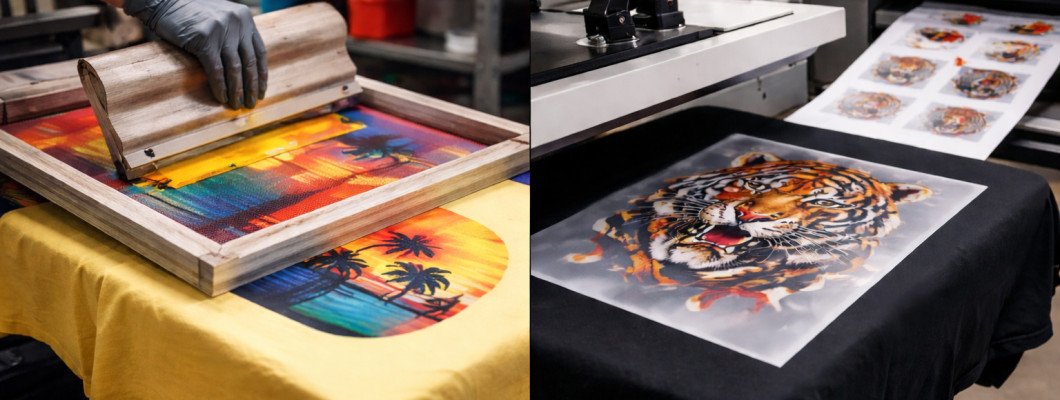
If you are planning to print custom t-shirts, sooner or later you will hear the same two options mentioned over and over again: screen printing and DTF (Direct To Film). Both methods are common in the custom apparel world, and both can produce good-looking results.
The problem is that most explanations focus on the technology itself, not on what actually matters to you as a customer. When you order t-shirts, you usually care about three things above all: how much they cost, how long they take to arrive, and how well they hold up after washing.
This article is written for people who simply want to print t-shirts without unpleasant surprises. No technical jargon, no hype—just a clear comparison between screen printing and DTF, with a strong focus on price, timing, and real-world quality.
1) Screen Printing vs DTF: What This Choice Really Means for Customers
DTF is often presented as the “modern” option, while screen printing is sometimes described as old-school. In reality, that distinction is misleading. The real difference has very little to do with age and everything to do with how each method behaves when your order grows.
DTF is extremely convenient for very small quantities. Screen printing takes more preparation at the beginning, but once production starts, it becomes far more efficient. That difference is what drives the final price and delivery time.
In practical terms, once you move beyond just a few t-shirts, screen printing often becomes both cheaper per shirt and faster overall.
2) Screen Printing: A Proven Method That Still Makes Sense
Screen printing has been used for decades, and there is a good reason for that. It relies on a polyester screen printing mesh stretched on a frame and coated with a photosensitive emulsion.
The artwork is transferred using a film positive. Ink is then pushed through the open areas of the mesh and printed directly into the fabric. Each color has its own screen.
Before printing starts, the printer performs a series of initial print adjustments: alignment, ink deposit, pressure, and curing settings. This preparation takes time, but once it is done, production runs smoothly and consistently.
3) DTF Printing: Flexible and Easy, but with Limits
DTF printing works in a very different way. The design is printed onto a special film, coated with adhesive powder, cured, and then transferred onto the t-shirt using a heat press.
Many customers like DTF because it allows very detailed, full-color designs without worrying about color limits. It is also useful when each shirt needs a different design.
That flexibility is real—but it comes at a cost, especially when the number of shirts increases.
4) Cost Comparison: Screen Printing vs DTF for T-Shirts
Screen Printing Cost per Shirt
With screen printing, most of the cost happens at the beginning. This includes preparing film positives, exposing screens, and setting up the press. These steps are done once for the entire order.
After that, each additional shirt is relatively inexpensive to print. Ink usage is efficient, and the press works quickly. The result is simple: the more shirts you order, the lower the cost per piece.
For orders of 30, 50, 100 shirts or more, screen printing is usually the most economical option.
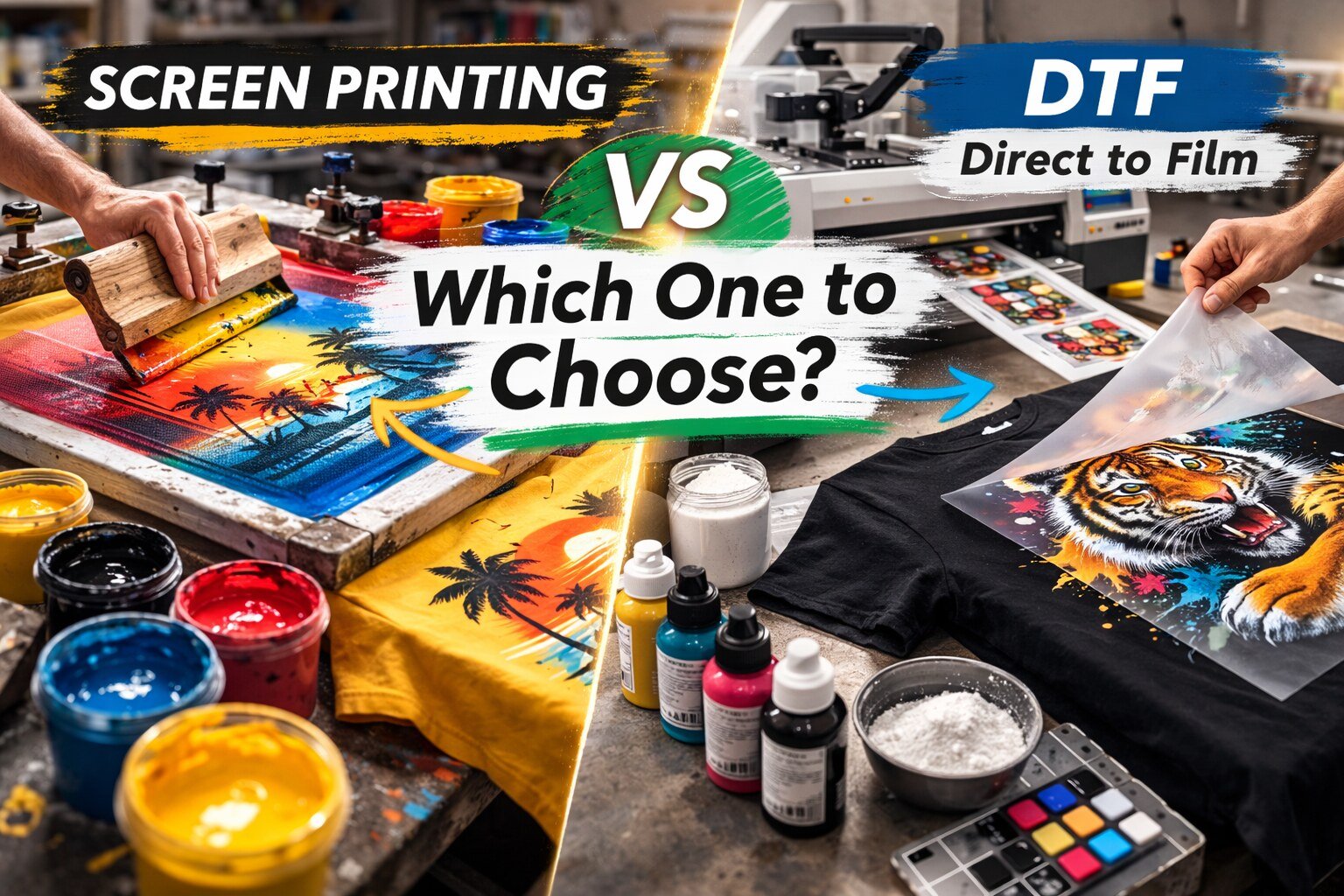
DTF Printing Cost per Shirt
DTF has very little upfront setup, which can make it look cheaper at first. However, every single shirt requires its own transfer, adhesive powder, curing, and heat pressing.
Because these steps repeat for each garment, the price per shirt stays almost the same, no matter how many you order. For larger quantities, DTF often ends up costing more than screen printing.
5) Production Time: How Long Will Your Order Take?
DTF Production Time
DTF allows printing to start quickly, since there are no screens to prepare. But each shirt must be handled individually, which adds time as quantities grow.
Even if transfers are prepared in batches, the heat press stage still happens one shirt at a time.
Screen Printing Production Time
Screen printing takes longer at the beginning, but once production starts, shirts can be printed in a steady flow.
For medium and large orders, screen printing often finishes sooner overall, despite the longer setup phase.
6) Why Quantity Is the Deciding Factor
Quantity changes everything. For a handful of shirts, DTF may be perfectly fine. But as soon as the order grows, screen printing becomes more efficient.
This is why screen printing is commonly used for events, company apparel, team shirts, and merchandise that needs to be reordered later.
7) Quality, Durability, and How the Print Feels
Screen Printing Durability and Feel
When done properly, screen printing is extremely durable. The ink becomes part of the fabric, which helps it withstand frequent washing.
Depending on the ink and technique, the print can feel soft and breathable or bold and solid. This flexibility is one of the reasons many brands prefer screen printing.
DTF prints can look very sharp, but they sit on top of the fabric as a transfer layer. On large designs, this layer can feel thicker and less breathable.
8) Final Thoughts: Which Method Should You Choose?
DTF is a useful option for very small orders, urgent jobs, or designs that change from shirt to shirt.
However, for most customers who want to print t-shirts in medium or large quantities, screen printing remains the better choice. It offers lower cost per shirt, more predictable production times, and prints that last longer.
If your goal is to get quality t-shirts at a fair price, delivered on time and made to last, screen printing is still the safest and smartest option.
Leave a Comment